


At Investing Hero, I aim to provide the best investing platform reviews. To support this, some of the providers featured in reviews will generate an affiliate commission which helps pay to run this website. However, this doesn’t influence my reviews. My opinions are my own. The information provided on Investing Hero is for informational purposes only. Please read the disclaimer.
Short version for everyone who searched for ValuePension: it still exists, it just changed its name. ValuePension was finpension’s vested benefits product, and in the brand consolidation it simply became finpension Vested Benefits. Same foundation idea, same low-cost philosophy, one app. This page stays up because plenty of people still know it by the old name, and because the product remains my pick for parking a 2nd pillar properly.
Figures from finpension’s own vested benefits page, checked on 9 August 2026.
ValuePension is now finpension
The rename changed the label, not the machine. Your money sits with a finpension foundation, the strategies follow the same index-fund logic as their pillar 3a (my top-rated 3a at ★ 4.7), and everything runs in the finpension app next to your other pots. If you hold a legacy ValuePension account, you are already a finpension customer; nothing to do.
What is a vested benefits account?
When you leave a Swiss employer without joining a new pension fund straight away, career break, sabbatical, self-employment, moving abroad, your 2nd pillar money has to go somewhere. That somewhere is a vested benefits account (Freizügigkeitskonto). The default route parks it at a bank at near-zero interest, sometimes for years. The smarter route invests it, because this is retirement money with a long horizon anyway, and that is exactly the niche finpension Vested Benefits fills.
Fees & Charges
finpension charges 0.49% a year on the vested benefits solution, with no minimum fee and no obligation to deposit. Compare that with the classic insurance-linked vested benefits products, where opaque fees quietly eat a percent or more, and with bank accounts paying next to nothing, and the maths write themselves. As always with finpension, the strategies use institutional index funds, and you choose how much risk the money takes.
How to open an account with Valuepension
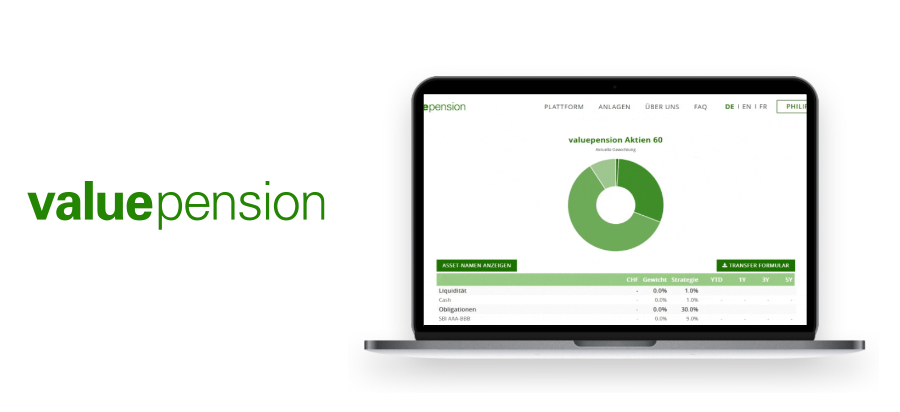
Today this means: download the finpension app, choose Vested Benefits, and follow the steps. The screenshots below are from my original ValuePension walkthrough; the branding has changed to finpension since, but the flow, transfer form included, is still recognisably the same.



VIAC vs valuepension
Both offer investing your vested benefits at low cost, and both are miles ahead of doing nothing at a bank. The differences are the same as in the 3a comparison: finpension gives you the most aggressive equity options and institutional funds; VIAC counters with its banking integration. For pure vested benefits parked long-term, I lean finpension, and the full reasoning lives in my finpension review.
My rules for vested benefits money
- Never leave it in cash for years.A vested benefits account at zero interest is a slow leak. If the horizon is long, the money should be invested.
- Match the equity share to the timeline.Back in a pension fund next year? Stay conservative. A decade of self-employment ahead? That is what equity strategies are for.
- Consider splitting into two foundations.Two accounts can mean staggered withdrawals and lower taxes later. Cheap to set up now, valuable at retirement.
- Watch the exit costs of the old providers.Insurance-linked vested benefits products can sting on transfer. Check before you move, then move anyway if the maths say so.

Vested benefits parked at zero interest lose quietly every year. Opening the finpension solution takes minutes, and the reader code below credits your first fees.
Valuepension FAQ
What happened to ValuePension?
It was renamed. ValuePension was finpension’s vested benefits offering and now runs as finpension Vested Benefits, in the same app as their pillar 3a and 1e products. Existing accounts carried over automatically.
What does finpension Vested Benefits cost?
0.49% a year, with no minimum fee and no deposit obligation, per finpension’s own page (checked 9 August 2026). Fund costs use institutional share classes.
Is my 2nd pillar money safe there?
It sits with a regulated Swiss vested benefits foundation, separate from finpension the company. Investment risk is yours and depends on the strategy you choose; the cash-only strategy exists for the cautious.
Can I split my vested benefits between two accounts?
Yes, on leaving a pension fund you can split into two foundations, which can reduce taxes through staggered withdrawals later. finpension supports multiple portfolios.
finpension or VIAC for vested benefits?
Both are excellent and cheap. finpension offers the more aggressive equity options and institutional funds; VIAC offers its banking ecosystem. My fuller take is in the finpension review.
Do I need this if I am just changing jobs?
Usually not: your new pension fund takes the money directly. Vested benefits accounts are for the gaps, sabbaticals, self-employment, leaving Switzerland, unemployment.
Figures from finpension’s vested benefits page, checked on 9 August 2026. Spot something outdated? Tell me and I will fix it.
- finpension: Vested Benefits, product page (9 Aug 2026)


