


This page is also available in:
 Deutsch
At Investing Hero, we aim to provide the best investing basics. To support this, some of the products featured in articles will generate an affiliate commission which helps pay to run this website. However, this doesn’t influence our evaluations. My opinions are my own. The information provided on Investing Hero is for informational purposes only. Please read our disclaimer for more.
A practical guide to investing from Switzerland: what to put your money in, who to open an account with, and what it costs. Every provider figure quoted here links through to a comparison where the fee was checked against the provider’s own pricing page.
By the end of this guide you’ll have the knowledge, tools and a step by step check list needed to take the next steps in your investing journey.
I will provide plenty of additional tips throughout this guide too. We have a lot to cover here, so prepare your drink of choice, get comfy, and let’s get started.
Beast Alert: This is a huge 5000+ word guide. Make sure to use the table of contents below to find the topics relevant to you – we’ll start with some basics before moving onto the options available in Switzerland.
Who is this investing guide for?
- Cost is the only thing you control. You cannot pick next year’s returns. You can decide whether 0.15% or 1.5% leaves your account every year for the next thirty.
- Fill the pillar 3a before the taxable account. The tax deduction is a guaranteed return no market offers.
- One global fund beats five clever ones. Complexity is not sophistication, and it usually costs more.
- Automate it, then stop looking. A standing order removes the decision you are most likely to get wrong.
- The portfolio you will not abandon is the right one. The best allocation on paper is worthless if you sell it in a crash.
As a British expat landing in Switzerland 10 years ago, learning about investing was hard.
Finding reliable, fact-based and unbiased investing information, in English, tailored to Switzerland was a challenge.
I’ve learnt the hard way – from thinking that bundling life insurance into a pillar 3a was a good idea, to buying individual stocks with a bank, I’ve made lots of mistakes.
But from those mistakes, I’ve also been able to make better and more informed decisions.
So this guide is for anyone that is looking to start investing, and can relate to the above.
Should I start investing?
Woah there. This guide isn’t about ‘the why’ on whether you should start investing or not.
You’ve likely landed on this page having searched Google for ‘how to start investing’ or ‘investing in Switzerland’ – so you are probably aware of the benefits of investing.
You already understand the powers of compound interest over the long term, which even Albert Einstein described as being ‘the eighth wonder of the world’.
If you need a quick refresh, here’s a few links below to recap:
- Video: The Power of Compound Interest (4mins)
- Calculator: Compound Interest (use a 7% estimated interest rate)
- Investing Hero: Investing basics & investing guides
Remember, the best time to invest was 20 years ago. The second-best time is right now.
But if you haven’t already, spend some time working out your ‘why’ to doing all of this in the first place. What’s your ‘north star’ in investing your money?
Why do you really want to have X CHF in Y years’ time?… And Why should you answer that?
Because investing can get real. Gut wrenching ‘wtf am I doing’ type real, and quickly.
When I first wrote this guide, in spring 2020, the S&P 500 had just fallen 34% in 33 days, from its February high to its March low.
Picture that for a second.
You’ve transferred 100K CHF from your life savings into an investment account, and next month the account value is at 70K CHF. How would that make you feel?
You might panic and do something crazy, like closing your investing account and stomaching the loss. And you don’t ever want to do that.
» Related reading: My favourite investing books for newbs
Without a ‘north star’ plan, that 30% market drop will mess you up.
The Foundations for Successful Investing in Switzerland
Two things decide how a Swiss portfolio behaves, and neither is stock picking: how long you are leaving the money, and how much of a fall you can sit through without selling. Everything else is detail.
| If your horizon is | A sane shape | What to expect |
|---|---|---|
| Under 3 years | Cash, and the 3a filled but not in equities | Money you need soon has no business in the market. A bad year would force you to sell at the bottom. |
| 3 to 10 years | Roughly half equities, half bonds and cash | Falls of 15 to 20% are normal and recover. You should be able to ignore them. |
| 10 years or more | Mostly equities | Falls of 30 to 40% happen roughly once a decade. Time is what turns that from a disaster into noise. |
The honest test. Look at the highest-equity option you are considering and ask what you would do if it fell 35% in six months. If the answer is anything other than “keep paying in”, you want less equity than you think. The right portfolio is the one you will not abandon.
Swiss cash investments – What are the options in Switzerland?
These are the things you can actually put money into from Switzerland. You do not need all of them. For most people the honest answer is a global equity ETF, a bond fund, and nothing else.
| What | Risk | What it is for |
|---|---|---|
| Stocks | High | A share of a company. The engine of long-term growth, and the reason a portfolio moves the way it does. Owned through a fund rather than one at a time by most people. |
| Bonds | Low | A loan to a government or company. Dampens the ride. Swiss bonds have paid very little for years, which is why many Swiss portfolios hold few of them. |
| ETFs | Follows what it holds | Not an asset class but a wrapper: one purchase that holds hundreds of stocks or bonds. This is how most sensible Swiss portfolios are built, and what every robo-advisor uses. |
| Real estate | Medium | Buying property is out of reach for most people here. A property fund or REIT gives the exposure without the mortgage. |
| Precious metals | Medium | Gold pays no income and produces nothing. A small holding as insurance is defensible; a large one is a bet. |
| Crypto | Very high | The most volatile thing on this page. Owning none is a perfectly reasonable position. |
| Peer to peer | High | Lending to strangers for interest. Sounds like a savings account, behaves nothing like one. Small allocation or none. |
If you take one thing from this section: a single global equity ETF, bought monthly and left alone, beats almost every complicated thing a beginner is tempted into. Complexity is not the same as sophistication.
What might an investing portfolio look like?
All of these options – stocks, bonds and precious metals amount to a big long list!
So let’s have a look how these might look in a portfolio, when you bring them all together.
These are just examples – your personal situation will differ, so don’t take this as ‘financial advice’. Please remember, I’m not a financial advisor.
Higher risk example (think Ambitious Amanda) to build capital over the long term:
> Related reading: What should you have in an investment portfolio?
As you can appreciate there are thousands of potential combinations for a portfolio.
And once you decide on your risk and portfolio allocation, getting into the different types of stocks, bonds and REITs (e.g. which ETF should you pick…) is another step down the rabbit hole.
But for now, hopefully the simple portfolios above give you an idea of how the split might look like.
How to start investing in Switzerland
Cost ranges from my robo-advisor, broker and pillar 3a comparisons, each checked at source. 3a maximum from the ESTV.
| Route | All-in cost | Effort | Best for |
|---|---|---|---|
| Swiss bank fund | 1.0 – 1.8% | None | People who want the branch and will pay for it. The most expensive way to own the same index. |
| Robo-advisor | 0.4 – 0.9% | An afternoon to set up, then none | Most people starting out. It builds and rebalances the portfolio for you. |
| Broker, do it yourself | ~0.15% | A trade every month or quarter | Anyone comfortable buying a global ETF and leaving it alone. |
The gap is not small. On CHF 100,000, the difference between a bank fund at 1.4% and doing it yourself at 0.15% is about CHF 1,250 a year, every year, before it compounds.
Finally, the information you came for. What are the best ways to invest your money in Switzerland, and how can you get started?
We’ll be looking at three main ways to understand how to invest in Switzerland:
- With a bank
- Robo Advisor
- Hands on ‘DIY’
I’ll take you through the pros and cons for each option, step by step.
Let’s get started!
Investing with a Swiss bank
Investing through your existing bank is a common route for many first time Swiss investors.
You already have your local bank contact; they handle the portfolio and you don’t need to got through the swiss bank account opening process with another provider. It’s easy to understand why many opt for this convenience and use this trusted, safe partnership.
Banks offer a huge range of different funds and options to invest your money and cater for all types of investors and risk models.
That said, the big downside with investing with a swiss bank are the fees, and they are easy to overlook when you are landed with a glossy 50-page investing brochure.
Keep in mind, as we explained above, your portfolio will comprise of a combination of stocks, bonds, REITs etc. Each of these assets will have their own underlying costs, which combined will ultimately reduce the impact of your initial investment.
This means fees are important, amplified even more so over the long term. Ignore them at your peril.
Let’s take an example I pulled at random, one of the popular UBS Strategy funds:
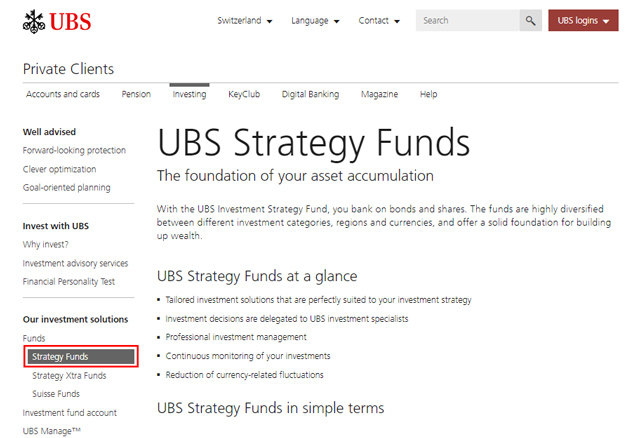
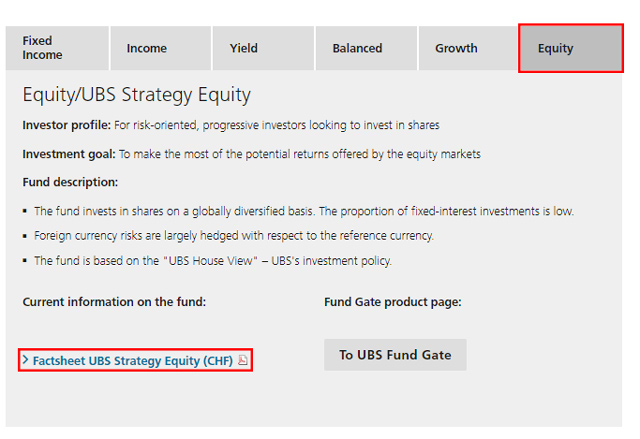
Scroll down to the fund options, I’ll pick the Equity version in this example, and open the PDF factsheet:
With any factsheet, all banks now need to display the ‘Ongoing charge’ figure (previous they used the ‘TER’ or ‘Total Expense Ratio’) which I’ve highlighted in the PDF factsheet below:
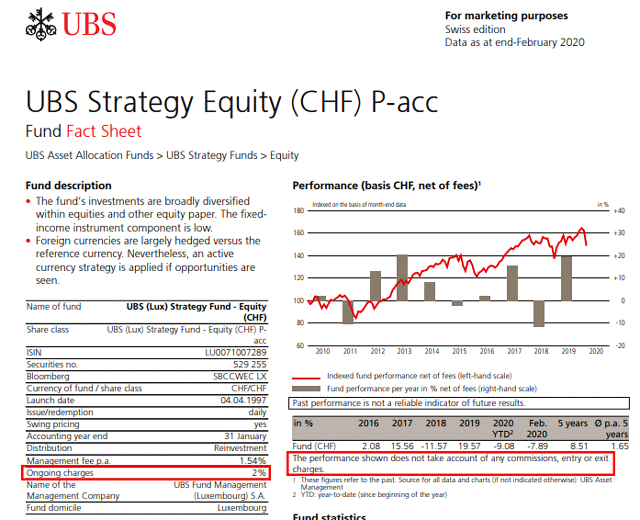
You’ll note this is 2%. As explained in the PDF, this 2% fee excludes other costs such as entry and exit fees and transaction costs throughout the year.
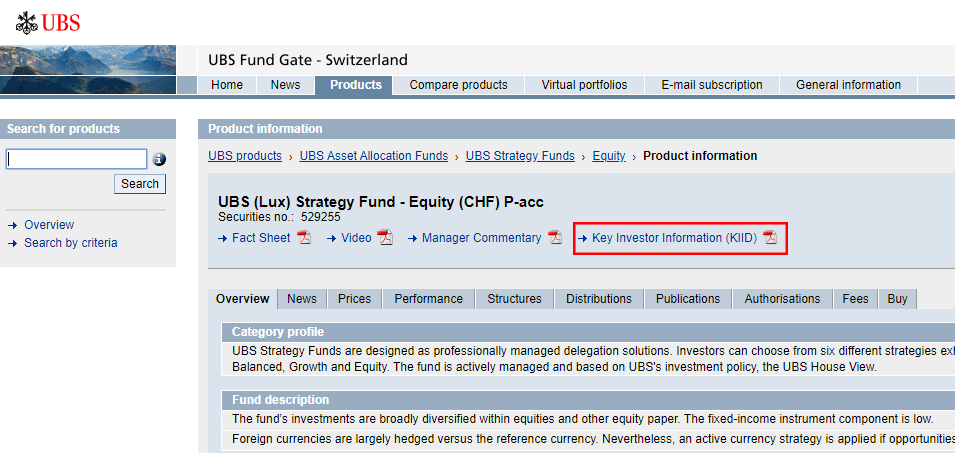
And to find those, we need to browse to the UBS Fund Gate:
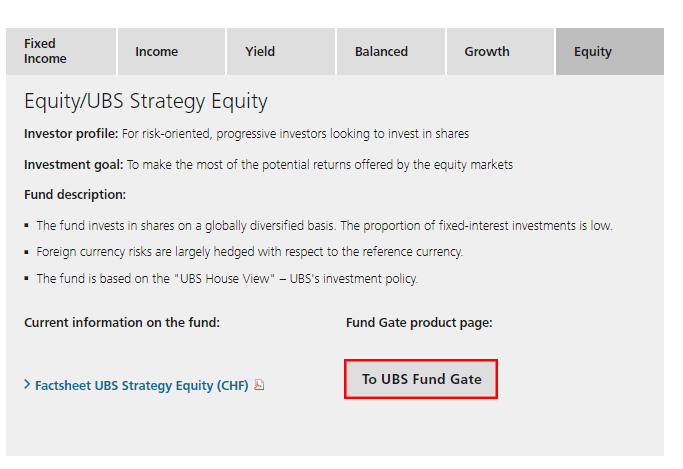
…to find the ‘Key Investor Information’ PDF.
And then scroll down to page 2 of the PDF to see these figures:
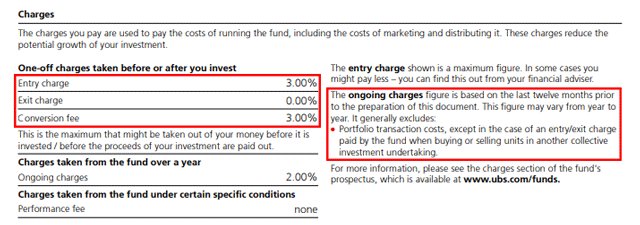
A 3% entry fee, which means as you sign the contract and deposit 100K of your savings, they take 3K on day 1. You’ll notice there is no exit fee in this example, however this is generally quite typical with other bank funds.
There is a 3% ‘conversion fee’ – which applies when you convert your investment into CHF and withdraw it. As this fund contains 52% in foreign currency, this is another sizable chunk of cost on your investment.
Finally, there are transaction costs not included in the above fees. Unfortunately, I couldn’t find this figure anywhere despite looking through various PDFs and throughout the website. None the less, it’s another cost you need to remember to factor in as they are triggered on every buy and sell in your potfolio throughout the year.
Investing with a Swiss bank – Pros and Cons
| Pros | Cons |
|
|
Investing with a Swiss robo advisor
Robo advisors are ideal for newcomers to investing as they take care of the all the things that would otherwise put you off with taking those first steps. I keep a full comparison of every Swiss robo-advisor, with each fee checked at source.
For example, they’ll calculate your risk, work out your portfolio, and buy and sell assets on autopilot without you needing to touch anything.
The nice thing is, if you want to geek out and learn more – everything is there to tinker with and tweak if you wish to do so.
For example, if you find you are comfortable with more risk, you can update your account to reflect that, and the algorithm will update your portfolio. Here’s an example of the Selma Finance platform:
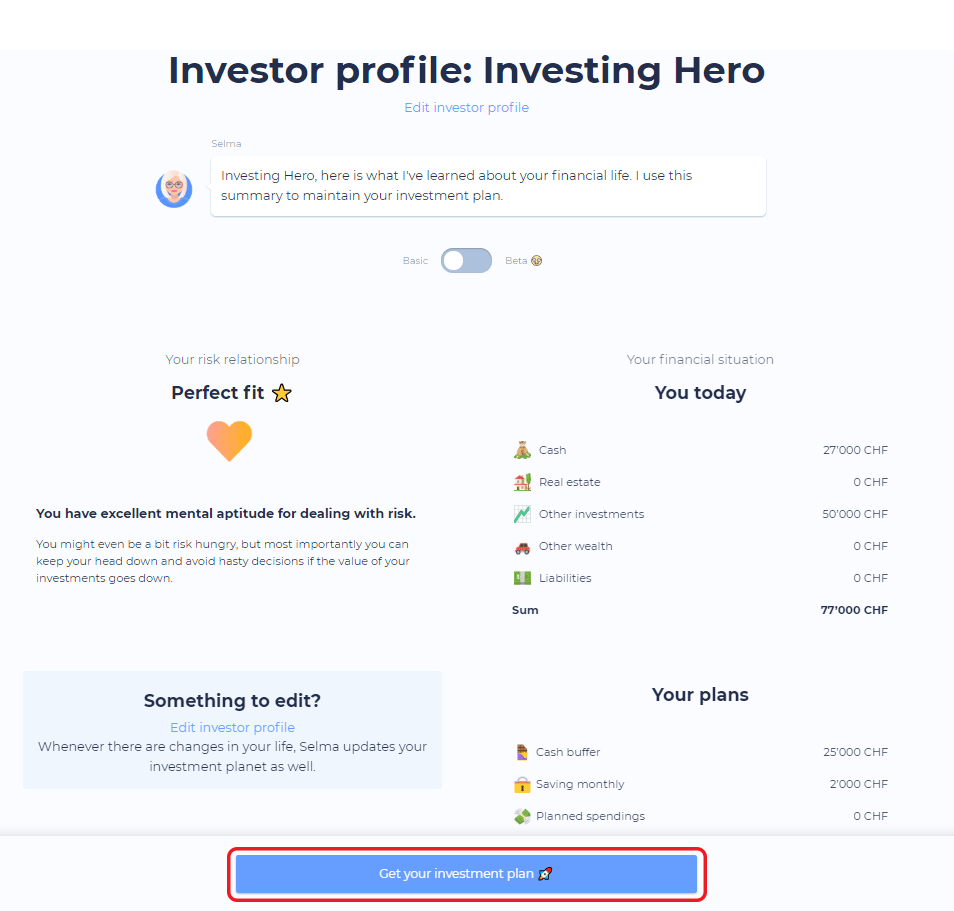
The big players are pretty good cost wise, hugely undercutting banks, and in general onboarding and customer experience is excellent. Robo advisors are a logical first step for newcomers looking to get started with investing.
Investing with a Swiss robo advisor – Pros and Cons
| Pros | Cons |
|
|
Two answers, depending on how much hand-holding you want.

The most established platform of the three, the most control over what you own, and a fee that falls as you grow. Needs CHF 8,500 to start.
Visit True WealthReader offer: CHF 100 fee credit with code INVEHERO
Start with CHF 2,000, get walked through the whole thing, and get real people on the other end when you have a question. You pay more for that, and for a lot of readers it is the reason they actually start.
Visit SelmaReader offer: free management for a full year via this linkOn cost alone VIAC Invest is cheaper still at 0.45% to 0.52%, with custody, transactions, currency conversion, stamp duty and VAT all inside that figure and no minimum. I have tested VIAC’s pillar 3a but not Invest, so I am not rating it yet.
Investing with a Swiss broker – aka. the DIY approach.
For those that are keen to get their hands dirty creating a portfolio, find the assets they want to buy, and make the transactions themselves – you can do so easily through a broker in Switzerland.
The DIY approach is, by far, the cheapest way to purchase stocks in Switzerland.
Some brokers, such as DEGIRO, even offer a list of ETFs you can trade for free every month, bringing the cost down even further.
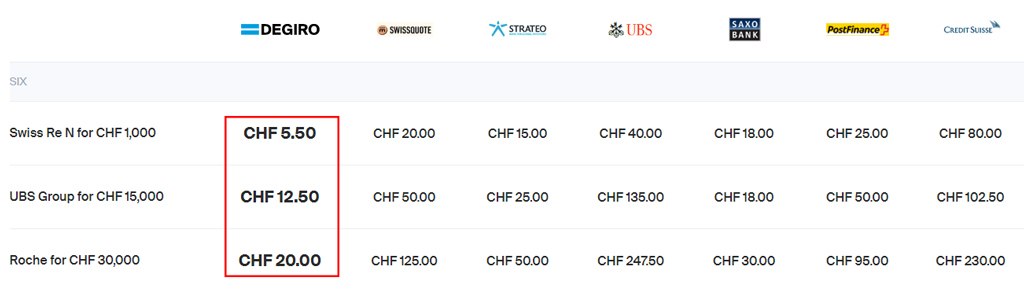
You can buy individual stocks through a bank, however when compared to the likes of Swissquote, Interactive Brokers and DEGIRO they’ll come out a lot more expensive.
Here’s an example taken from our recent DEGIRO review that shows that cost comparison:
» Related reading: Read the full DEGIRO review.
While building your own portfolio is straight forward and cost effective, for some the DIY approach will be too much.
If the idea of buying stocks every month through a broker platform isn’t for you, that’s understandable – you might want to consider the robo advisor route instead.
Investing with a Swiss broker – Pros and Cons
| Pros | Cons |
|
|
What about investing the Pillar 3a?
I sneaked this one in at the end – but yes, you can invest (and probably should!) your Pillar 3a pension contribution. What they charge varies enormously. My pillar 3a comparison puts every Swiss provider side by side on total cost, from 0.14% to well over 1%.
Banks, robo advisors (although just Selma Finance for now) and dedicated pillar 3a providers (e.g. VIAC) offer the ability to have your pillar 3a invested.
Aside from a few reasons (mortgage, leaving the country etc) due to the nature of the pillar 3a being pretty ‘untouchable’ until you reach 60+, the timeframe alone generally makes sense for most of us to have it invested and generate some solid long-term returns.
Despite the benefits listed above, there is some dispute on the value of the pillar 3A if you are already investing heavily elsewhere.
However, the general feeling is yes – they are worth contributing toward for the tax benefit if you can combine it with an inexpensive investment provider, such as VIAC.
» Related reading: Read the full VIAC review.
Remember do not, ever, combine your pillar 3a with a life insurance policy.
How much money do I need to start investing?
The amount you need will depend on the way you choose to invest.
Banks have very low (under 100CHF) account minimums, and via the DIY route with the likes of DEGIRO you can open an account for 1CHF. However, you won’t be able to buy much with that 🙂
Robo advisors have slightly higher deposit minimums, as they already operate on tight margins and need to cover their back-office costs. Selma Finance for example require 2K CHF to start, True Wealth 8.5k CHF.
How much you want to invest depends on your goals, timeframe, risk appetite and your budget. Once you have those, you’ll arrive at your figure.
But more importantly once you open an investing account, you commit regular CHF into it.
Common pitfalls when investing in Switzerland
Three that cost Swiss beginners the most:
Paying a bank 1.5% for an index you could own for 0.15%. Over thirty years that gap eats a meaningful share of the final pot.
Leaving the pillar 3a in cash. The tax deduction is only half the point. Uninvested 3a money has been quietly losing to inflation for years.
Selling in a crash. Every long-run return figure you have read assumes you were still holding at the bottom. Most people who lose money in markets do it here.
There are more, and they are worth knowing before you start: 8 investment mistakes to avoid.
Your first four steps
- Clear expensive debt and hold a cash buffer. Three to six months of costs, in an account you can reach. Investing borrowed money at 8% while paying 12% on a card is a losing trade.
- Fill and invest your pillar 3a first. It comes with a tax deduction, which is a guaranteed return no market gives you. Most Swiss 3a money still sits in cash, earning nothing. Compare the providers on total cost in my pillar 3a comparison.
- Pick one home for your taxable money. A robo-advisor if you want it handled, a broker if you would rather buy the ETF yourself. Both are compared here: robo-advisors and brokers.
- Set a standing order and leave it alone. Monthly, automatic, boring. The portfolio that exists and is left alone beats the cheaper one you never built.
Swiss Investing FAQ
Is investing in Switzerland risky?
No more so than other countries, but all investing carries risk. The amount of risk you are willing to take will depend on your personal profile, but generally the more stocks you hold in a portfolio, the greater the risk. See the section above for more detail.
Can a foreigner invest in Switzerland?
Yes – In general to open a swiss bank or robo advisor account in Switzerland you need to have B or C permit. With these at hand, the process is straight forward.
Where to invest my money in Switzerland?
There are generally three main options with investing in Switzerland, through a bank, robo advisor or directly with a broker. All have their pros and cons, to find out which is right for you read the section above.
Is investing a good idea?
Investing isn’t a good idea, it’s a great idea. The long term impact of investing will have a considerable impact on your overall wealth giving you more options and flexibility in the future.
How long should I invest for?
Typically when dealing with stocks to grow your wealth, you should conisder a timeline of 10+ yrs.
How much should I pay for investing in Switzerland?
All-in, most Swiss investors should be paying well under 1% a year. A robo-advisor runs roughly 0.4% to 0.9%; doing it yourself at a broker with a global ETF can be nearer 0.15%; a bank fund can be two or three times either. The comparisons are here: robo-advisors, brokers and pillar 3a.
What are the best robo advisors in Switzerland?
True Wealth for most people, Selma if you want to be guided, and findependent if you are starting small. I compare every Swiss robo-advisor on total cost, with each fee checked against the provider’s own pricing page, in my robo-advisor comparison.
Do I have to declare my investments for tax return?
Yes. Swiss residents declare worldwide assets and income, including securities, on the annual return, and most brokers and robo-advisors provide a tax statement to make that straightforward. How the tax itself works is covered in my guide to income tax in Switzerland. If your situation is more involved, with self-employment, assets abroad, or a move in or out of the country, Ynoves are the Zug firm I work with and recommend, and the first consultation is free.
Compare & choose
The other comparisons on Investing Hero, each built the same way: every fee read from the provider’s own pricing page.
How this guide is kept current. Provider costs move, so this page does not repeat them. Fees live on the comparison pages: robo-advisors, pillar 3a and online trading, where each one is checked against the provider’s own pricing page and dated. Educational content, not financial advice.


Hi,
Very good thread!
Looks like you havent covered the pillar 2 for those who have vested benefits account?
Any chance to have similar article like you did for VIAC or Frankly for pillar 3a?
Ray
Good point Ray – the pillar 2 is also an option although often needs to linked into a higher cost banking fund. Waiting for some roboadvisors/VIAC to shake up this space.. 😉
Simply incredible! Thank you, Mr. IH! Great content as always.
Thanks for the feedback!
Thanks for this – very useful!
As a foreign resident in Switzerland on a B permit, my main concern with starting to invest is a lack of knowledge on what will happen once I leave the country, and settle somewhere else (in EU or not).
Some key questions: Would I have to sell all stocks and re-purchase upon moving? Would I be forced to close my robo advisor account, etc.
I have reached out to the local authorities / robo advisor providers, but there seem to be a lot of uncertainties on how it would work. Is there perhaps an article in the pipeline on this front?
Very nice article and very useful. I appreciate your work, thanks for sharing for all the informative content.
Hi, thanks for the post! So you recommend Degiro vs Interactive Brokers? thanks
This is indeed a very useful read, thank you!
Would you know if a foreign resident on a CDL can invest in Switzerland?
Excellent website
Wonderful explanation! Thanks a million!